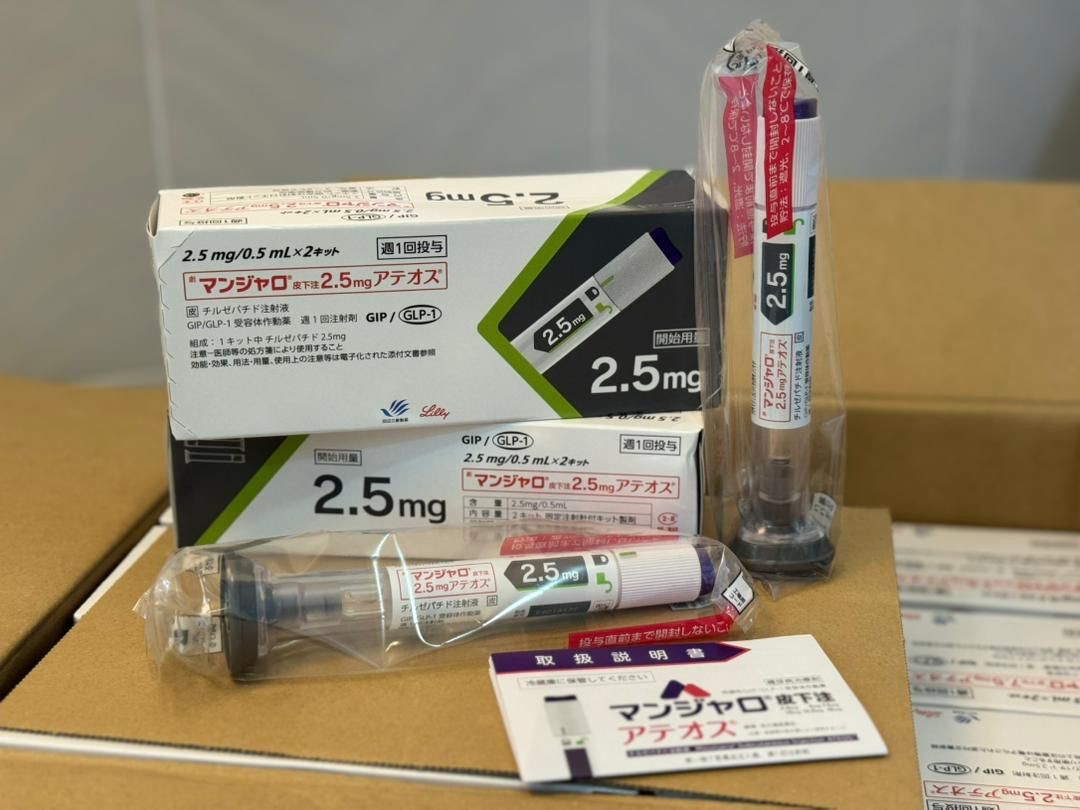
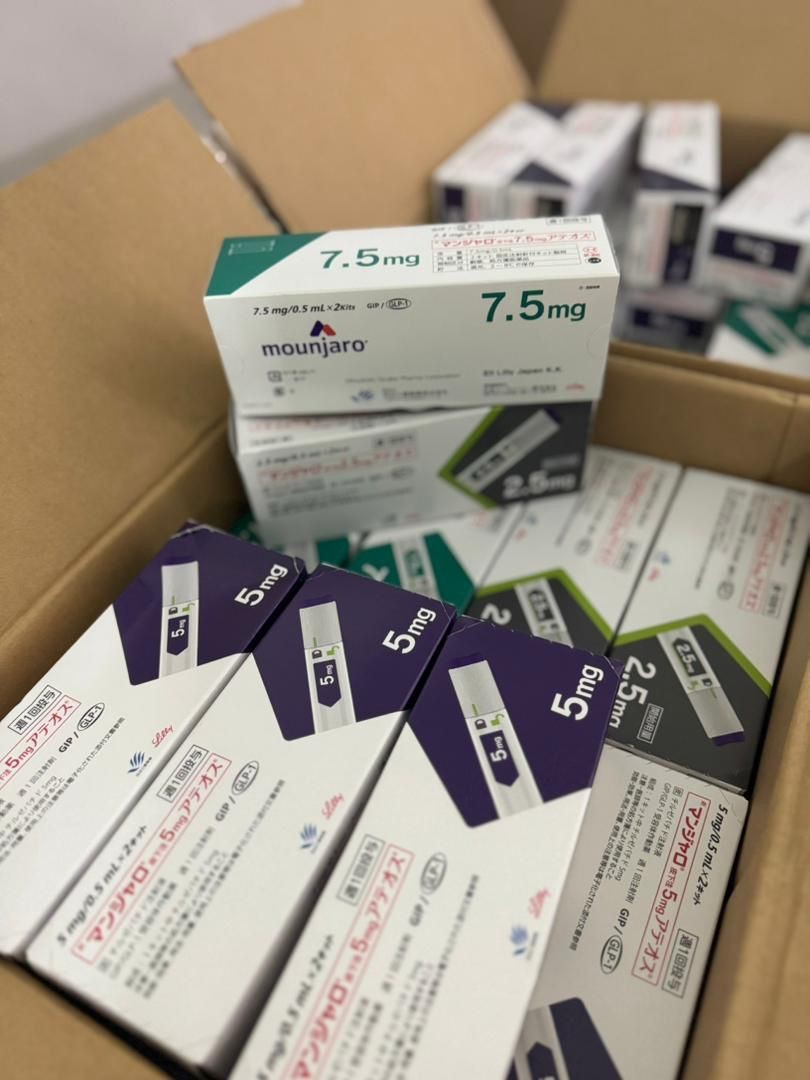

Monjaro Japan 2.5mg
What is Mounjaro (Tirzepatide)? "The world's first once-weekly GIP/GLP-1 receptor agonist."

Mounjaro acts on both GLP-1 and GIP receptors, making it a dual-action incretin therapy for weight loss. Clinical trials show Mounjaro has a stronger appetite-suppressing and weight-loss effect compared to traditional GLP-1 receptor agonists.
The impactful chart above shows the weight loss results from the clinical trial (SURMOUNT-1), comparing placebo (dummy drug) with Mounjaro (Tirzepatide).
For more details, please refer to the clinical trial section below.
Mechanism of Action of Mounjaro (Tirzepatide, GIP/GLP-1 Receptor Agonist)
GIP and GLP-1 are names of incretin hormones secreted by different cells in the small intestine.
GIP and GLP-1 are released after meals, promoting insulin secretion in a blood sugar-dependent manner while also suppressing appetite and slowing down gastrointestinal movement, making it harder to feel hunger. These effects naturally reduce food intake, leading to weight loss.
Additionally, incretin hormones act on various organs and are believed to help improve fatty liver and reduce cardiovascular risks.
GIP increases blood flow to abdominal fat tissue.
- GIP helps effectively break down and metabolize lipids (triglycerides) in fat tissue, reducing fat accumulation.
- In obese individuals, blood flow increase to fat tissue due to food intake or GIP is reduced, but studies suggest that this response can partially recover with weight loss.
- GIP directly promotes fat synthesis within adipocytes (fat cells).
- GIP enhances the activation of lipoprotein lipase (LPL), an enzyme involved in lipid breakdown and the uptake of circulating free fatty acids in human fat cells cultured outside the body.
- In isolated rat adipocytes, GIP improves insulin sensitivity, increases glucose uptake, stimulates new lipid formation, and promotes fat breakdown.
- In mice and non-human primates, reduced GIP function has been reported to decrease fat accumulation and lower the risk of diet-induced obesity.
Thus, in addition to the effects of GLP-1, the synergistic effects of GIP make Mounjaro more effective for weight loss.
What Makes Mounjaro More Impressive Compared to Previous GLP-1 Receptor Agonists Like Ozempic?
Until now, GLP-1 receptor agonists such as Ozempic, Saxenda, and Rybelsus, as their names suggest, acted only on "GLP-1".
However, the newly released Mounjaro is classified as a GIP/GLP-1 receptor agonist, meaning it acts on both GIP and GLP-1.
The diagram below compares GIP receptor agonists, GLP-1 receptor agonists (such as Saxenda, Rybelsus, and Ozempic), and GIP/GLP-1 receptor agonists.
Previous studies found that GIP alone did not significantly contribute to weight loss. However, when GIP enhances the effects of GLP-1, GIP/GLP-1 receptor agonists demonstrated superior efficacy in weight reduction, decreased food intake, and fat loss compared to GLP-1 receptor agonists alone.
(From top to bottom: GIP receptor agonist, GLP-1 receptor agonist, GIP/GLP-1 receptor agonist)
https://www.sciencedirect.com/science/article/pii/S0168822723005338
Mounjaro's Weight Loss Effects Introduction to Clinical Trials
SURMOUNT-1 Trial (Mounjaro vs. Placebo)
The SURMOUNT-1 clinical trial compared "Mounjaro (Tirzepatide) vs. Placebo (Inactive Drug)."
This clinical trial examined 2,539 participants with a BMI of ≥30 or ≥27 with non-diabetic comorbidities, who were administered the drug for 72 weeks, and the results were analyzed.
The above chart clearly demonstrates the remarkable effects of Mounjaro compared to the placebo.
(Gray: Placebo, Blue (from light to dark): Mounjaro 5mg / 10mg / 15mg)
Even at a lower dose of 5mg, Mounjaro showed significant weight loss effects, with an average weight reduction of -16kg.
Lancet. 2021;398(10295):143-55.
SURMOUNT-2 Trial (Mounjaro vs. Ozempic)
The SURMOUNT-2 clinical trial compared "Mounjaro (Tirzepatide) vs. Ozempic (Semaglutide / GLP-1 Receptor Agonist)."
This clinical trial targeted 1,878 patients with type 2 diabetes (on metformin, with an average BMI of 34.2), who were administered the drug for 40 weeks, and the results were analyzed.
The above chart clearly demonstrates the significant effects of Mounjaro compared to Ozempic 1mg.
(Gray: Ozempic 1mg, Blue (from light to dark): Mounjaro 5mg / 10mg / 15mg)
Surprisingly, even at just 5mg, Mounjaro showed a greater weight loss effect than the maximum dose of Ozempic 1.0mg.
N Engl J Med. 2021;385(6):503-15.
How to Use Mounjaro
Mounjaro Dosage
Mounjaro is administered once a week.
Starting dose: 2.5mg per injection, continued for 4 weeks. Maintenance dose: From the 5th week (5th injection), increase to 5mg per injection. The standard maintenance dose is 5mg.
If 5mg is insufficient, the dose can be gradually increased by 2.5mg at intervals of at least 4 weeks, but the maximum allowable dose is 15mg.

Eli Lilly|Mounjaro® (Tirzepatide)
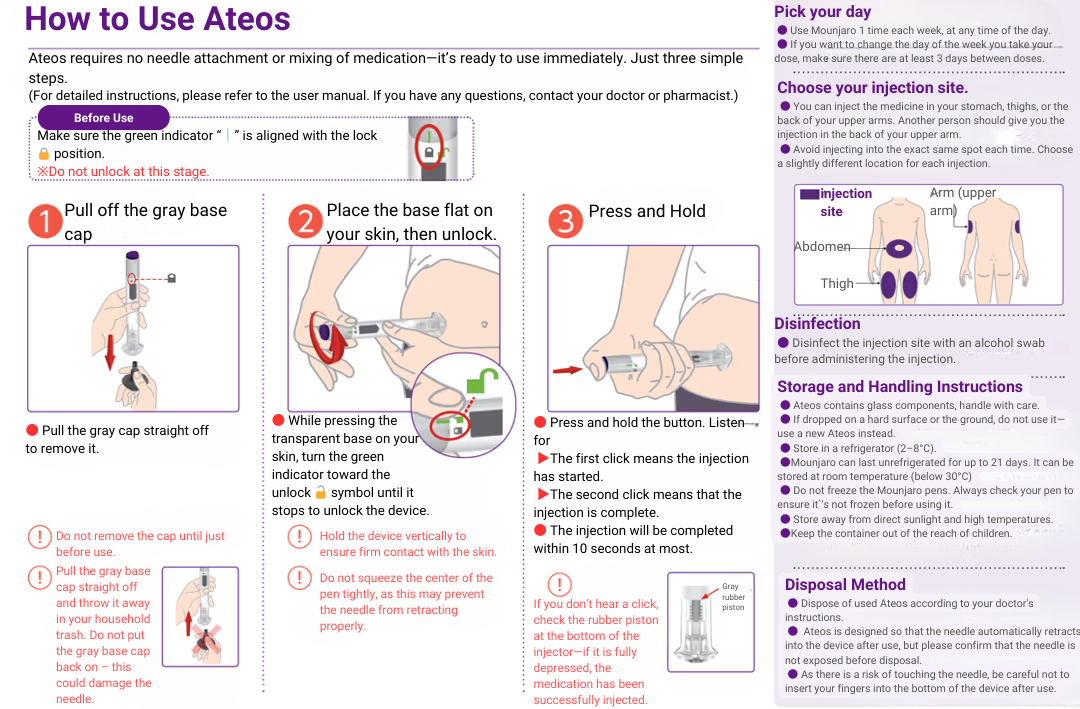
How to Inject Mounjaro
The injection process consists of just 3 simple steps!
- Remove the cap
- Press the base firmly against the skin to unlock
- Press the injection button and hold for 10 seconds
For more detailed instructions, please refer to the package insert included with the medication or the diagram below.
Eli Lilly|Mounjaro® (Tirzepatide)
What to Do If You Miss a Mounjaro Injection
The appropriate action depends on how much time has passed since the scheduled injection date:
- If less than 72 hours have passed, you can take the missed dose as soon as possible.
- If more than 72 hours have passed, please follow the instructions below.
If you are unsure or have concerns, please contact your clinic!

Eli Lilly|Mounjaro® (Tirzepatide)
Is It Really Okay to Inject Mounjaro Only Once Every 7 Days?

Eli Lilly|Mounjaro® (Tirzepatide)
As shown in the diagram, the blood concentration of Tirzepatide in Mounjaro follows a specific trend, with a half-life of approximately 5-6 days, allowing it to have a long-lasting effect. This makes once-weekly dosing possible, thereby reducing the injection burden on patients.
Since this is a long-acting medication, it is crucial to adhere to the once-every-7-days dosing schedule. Taking it daily or every two days is dangerous and should be avoided.
Who Should Not Use or Are Not Recommended to Use Mounjaro?
The following individuals should not use Mounjaro, and our clinic will not prescribe it.
- Individuals with a history of allergic reactions to this medication
- Individuals with a BMI below 23 (as noted in the official prescribing information)
- Individuals with severe gastrointestinal disorders (e.g., severe gastroparesis, as it may worsen symptoms even if previously unexperienced)
- Individuals with a history of pancreatitis or thyroid disease
- Individuals at risk of hypoglycemia Those engaging in intense muscle activity Those who consume excessive alcohol
- Pregnant women
- Breastfeeding women
- Elderly individuals
- Individuals taking birth control pills or warfarin (blood-thinning medication) (not strictly contraindicated, but may reduce drug efficacy)
Common Side Effects of Mounjaro
Mounjaro’s side effects are similar to those of GLP-1 receptor agonists, with a similar frequency of occurrence (though gastrointestinal symptoms are slightly more frequent).
In clinical trials, more than 5% of patients reported the following gastrointestinal side effects:
- Nausea
- Vomiting
- Diarrhea
- Constipation
As illustrated in the diagram, reducing portion sizes per meal, avoiding fried foods, and stopping eating when feeling full can help alleviate gastrointestinal discomfort.

Additionally, serious side effects to be aware of include:
- Hypoglycemia (Caution required when used with multiple medications): If you experience symptoms as shown in the diagram below, consume sugar immediately to counteract the effects.
- Acute Pancreatitis (Occurrence rate: less than 0.1%): Although rare, if you experience sudden severe abdominal pain, discontinue use immediately and seek medical attention as soon as possible.

Eli Lilly|Mounjaro® (Tirzepatide)
When Was Mounjaro (Tirzepatide) Released in Japan?
Mounjaro was approved in the United States in May 2022 and officially launched in June 2022.
Recently, it has also received approval from the European Medicines Agency (EMA).
In Japan, Mounjaro 2.5mg and 5mg were officially launched in April 2023, making it the latest GIP/GLP-1 receptor agonist.
Insurance Coverage for Mounjaro (Tirzepatide) in Japan
As of April 2023, Mounjaro is only approved as a treatment for type 2 diabetes in Japan.
For weight loss purposes, it is not covered by insurance and must be prescribed as a self-pay treatment.
However, clinical trials have demonstrated significant weight loss effects, and there is growing anticipation for its potential use as an anti-obesity drug.
Where Can You Buy Mounjaro (Tirzepatide)? Is It Safe?
If you would like to learn more about Mounjaro (Tirzepatide) or other medications, you can book a free online consultation at Mona Aoyama Clinic, where expert doctors and specialists will provide guidance!